Products

LNG Regasification Plant
regases LNG back to its gas state
which is mainly transported by network pipeline for a city or an indutrial park.
Send Inquiry
Product Introduction
Where is LNG Regasification Plant Applied?
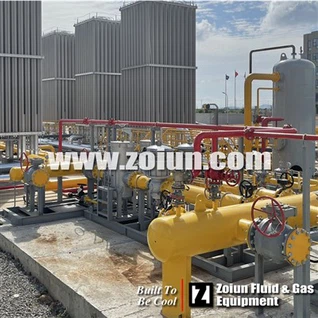
The primary task of an LNG regasification plant is to convert liquefied natural gas (LNG), which is at a temperature of -162 degrees Celsius (-260 degrees Fahrenheit), into gaseous natural gas and ensure it reaches the appropriate temperature for customer use. Typically, the plant utilizes a heat exchange process, with cryogenic storage tanks used for LNG storage and vaporizers serving as the main medium for the regasification process, with ambient air vaporizers being the most common type. Following the regasification, the gas undergoes pressure adjustment to maintain a stable gas pressure within a safe range for consumption. You can clearly see each equipment in the LNG REGAS project below.

Technical Parameters
Vaporization Pressure: 8 bar
Work Pressure After Regulated: 6 bar
Medium: LNG
Max Vaporization Capacity: 15000 Nm3/h
Relative Design: According to Temperature of -10°C, humidity of 70%
Operating Mode: One-to-one Backup & Usage, Switch Every 8 hours
Design Temp. : -196 ℃
LNG Regasification Plant Classification
LNG regasification plants can be classified into single-point direct supply regasification plants and LNG satellite plants, depending on the target of gas supply. They are designed to receive, store, and regasify LNG procured from upstream sources for local gas supply. Some regasification plants are equipped with natural gas liquefaction facilities and can also be regarded as small-scale receiving terminals.
Plant Design Requirements
1. Site Selection
The location of a regasification plant is closely related to its safety. Therefore, regasification plants should be situated in easily accessible areas away from densely populated areas. The fire separation distance between the plant and surrounding structures must comply with relevant standards.
2. LNG Storage
Storage tanks are the main equipment in an LNG regasification plant and have a direct impact on its regular production. They also represent a significant proportion of the overall cost. In small-scale regasification plants, vacuum powder-insulated low-temperature storage tanks are commonly used. These tanks have inner and outer layers with an intermediate space filled with perlite and evacuated to minimize heat transfer from the surroundings. This ensures that the daily regasification rate of LNG in the tank is below 0.3%.
3. LNG Vaporization
In a regasification plant, the gasification unit plays a crucial role in supplying gas to the external environment. Typically, ambient air vaporizers are used in the design. The vaporizers should have a gasification capacity of 1.3 to 1.5 times the calculated flow rate during peak gas consumption hours in urban areas, with at least two units and one standby unit. In colder ambient temperatures, if the outlet gas temperature from the ambient air vaporizer falls below 5°C, secondary heating is required to ensure the uninterrupted gas supply. Water bath heaters are commonly employed for natural gas heating purposes.

Contact Us
Reach us today to list your requests to our experienced engineers, your doubts or uncertainties will be professionally answered.
Hot Tags: lng regasification plant, China lng regasification plant manufacturers, suppliers, factory, gas skid branding, gas skid chemicals, gas skid leveling, gas skid turning, LNG Gasification Station Ambient Air Vaporizer Skid, LNG Satellite Regasification Plant Of Distributed Energy Resources
Previous:
Small Scale LNG Regasification Plant
Next:
LNG Regasification Unit
Send Inquiry